

If our team writes one document this season that matters more than any other, it’s the Engineering Portfolio. It’s 15 pages. It directly powers seven different FTC awards. And it’s also the document the judges actually read in the room.
Which awards does the portfolio actually feed?
Almost all of the awards a team can earn at an FTC event are evaluated at least partially through the engineering portfolio. The official rule is short and brutal: maximum 15 pages plus a title page. Anything beyond page 15 is not reviewed by judges. Every page has to earn its place.
Here’s how that one document maps to FTC’s judged awards:

- 🏆 Inspire Award — the grand prize. The portfolio is the proof of everything the judges look at.
- 📓 Think Award — awarded almost entirely from the engineering portfolio’s design-process content.
- ⚙️ Innovate Award — portfolio must describe the unique mechanism, with comparisons.
- 💻 Control Award — portfolio details software, sensors, and control logic (plus a separate 2-page submission).
- 🎨 Design Award — portfolio shows the aesthetic + functional design choices.
- 🔗 Connect Award — portfolio documents the team’s real engineering-community partnerships.
- 🎉 Motivate Award — portfolio shows team culture, recruiting, spirit, outreach.
- ⭐ Rookie All-Star — first-year teams advance to State on the strength of this document.
Bottom line: no portfolio = no awards. A great robot with a sloppy portfolio loses to a mediocre robot with a great one. FIRST set it up that way on purpose.
What goes in 15 pages
There’s no FIRST-mandated layout, but championship-level portfolios all hit roughly the same anatomy. Use this as a starting skeleton and adjust:
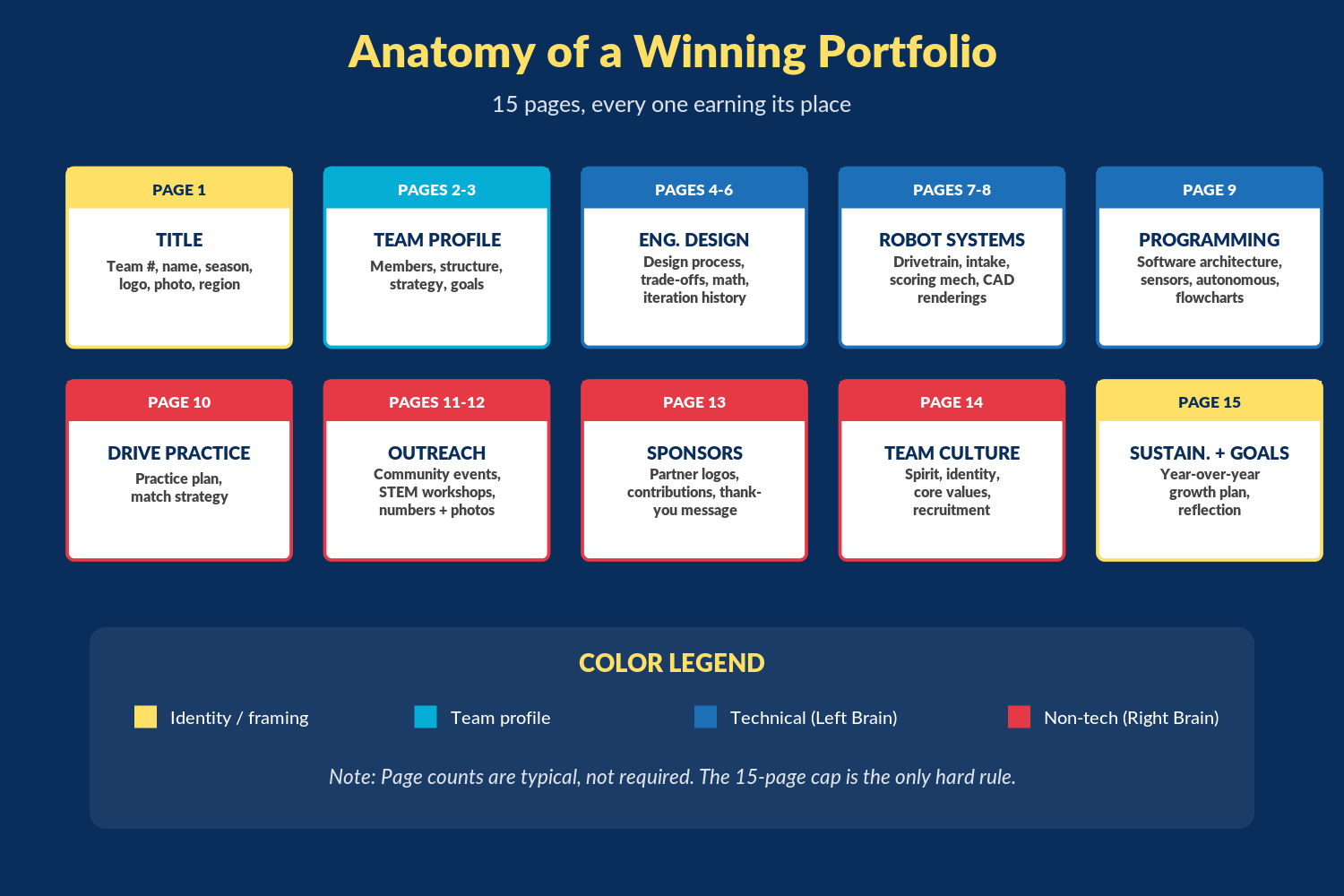
The split between technical (Left Brain) pages and non-technical (Right Brain) pages is roughly even. Teams that lean too far either direction get penalized: a portfolio that’s 12 pages of CAD and 3 pages of outreach won’t win Inspire; neither will the reverse.
What judges actually look for

The single most common mistake rookie teams make: writing about the robot instead of writing about the engineering process. Judges already see the robot. What they can’t see — what only the portfolio can show them — is how the team thinks: what was tried, what failed, what was changed and why, what the math said. The portfolio is your team’s brain on paper.
Where to study real winners
📚 The Hivemind Portfolio Library
Hivemind Robotics (FTC team 23396) maintains the largest public collection of award-winning FTC and FRC engineering portfolios. The directory pulls together submissions from across multiple seasons — from rookie teams that won Rookie All-Star up to multi-year Inspire Award winners and Worlds Championship teams.
How to use it well as a rookie team:
- Pick three to five winning portfolios from teams that won the awards you are targeting (Inspire, Connect, Rookie All-Star).
- Read them all the way through — not skimmed, not glanced at. Take notes on layout, voice, level of technical detail, and how they balance pages between technical and non-technical content.
- Make a list of what works. Color schemes that read well. Diagram styles that explain quickly. Sponsor pages that sell value, not just logos.
- Don’t copy. Ever. Your portfolio is graded on your story. Borrow structural ideas; never borrow content.
Our plan for this season
Build the portfolio alongside the robot, not after it. The teams whose portfolios feel polished are the teams that documented in real time — an engineering notebook that captured every meeting, every decision, every failed prototype. Then, before each event, the portfolio is assembled from the notebook in a few focused sessions, not written from scratch.
For our rookie season, the portfolio is also our most realistic path to State. Match performance is a tall order in year one. The Rookie All-Star Award is the path FIRST set up specifically for teams like ours, and it’s won on the page, not on the field.
15 Pages
Make every one of them count.