
FTC IS MORE THAN A ROBOT COMPETITION
Judges, Awards, and Scoring
When most people picture a robotics competition, they imagine robots driving around a field scoring points. And yes, that’s a big part of FTC. But here’s the surprise: you cannot win at the highest levels of FTC by robot performance alone.
Half the Path Runs Through the Judging Room
In FIRST Tech Challenge, judged awards carry enormous weight. Advancement from one level of competition to the next can be achieved either by winning on the field (50%) or by winning awards through judging (50%). That means half of a team’s path to the state championship and beyond runs directly through the judging room — not the playing field.
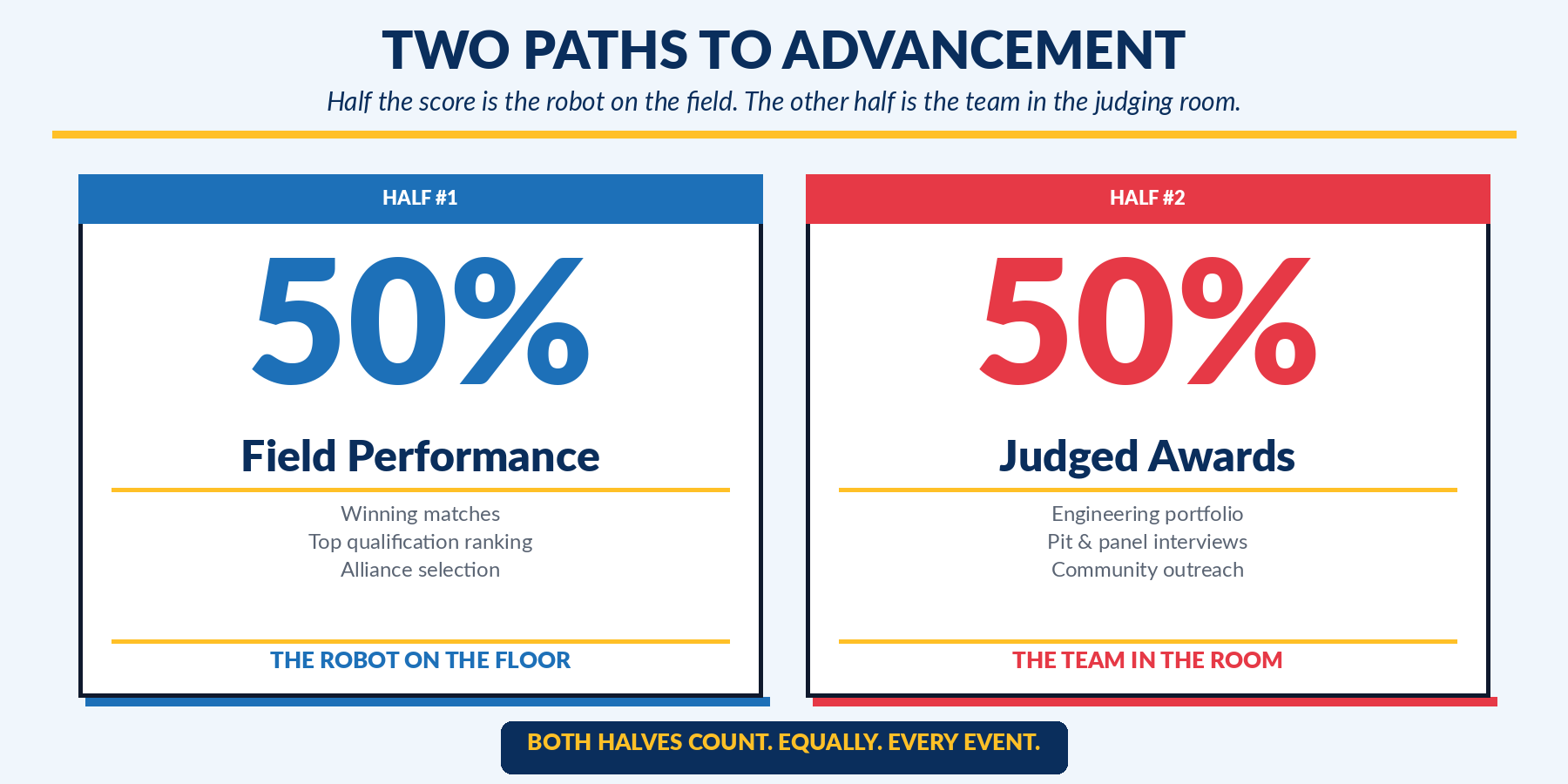
This is by design. FIRST wants to develop well-rounded students, not just robot builders. A team that builds an average robot but demonstrates outstanding engineering documentation, community outreach, and team spirit can advance just as far as a team with the most impressive machine on the floor.
The Engineering Portfolio: The Document That Rules Them All
Before we get into the awards themselves, every new FTC team needs to understand one critical fact: the Engineering Portfolio is necessary to be eligible for most FTC awards. It can be no more than 15 pages plus a title page. And any content beyond the allowed 15 pages will not be reviewed by judges. Every single page counts.
Your portfolio should tell the story of your team through the current season and include engineering content such as drawings, CAD, and math. This is most easily done by documenting both your team meetings and the progress of your robot in real time in an Engineering Notebook first. Then, when creating your portfolio before a competition, you can easily pull content from your notebook.
Think of the Engineering Portfolio as your team’s resume, journal, and proof of work — all rolled into one document. Building it well is not optional. It is one of the most important things your team will do all season.
The New Points-Based Advancement System
Starting with the 2025–2026 season, FTC moved to a fully points-based advancement model. Teams now earn advancement points throughout a single event based on both judged awards and match performance. At the end of the event, the teams with the highest advancement point totals move on to the next level of competition.
There are four ways a team earns advancement points at any event. Here’s the complete picture:
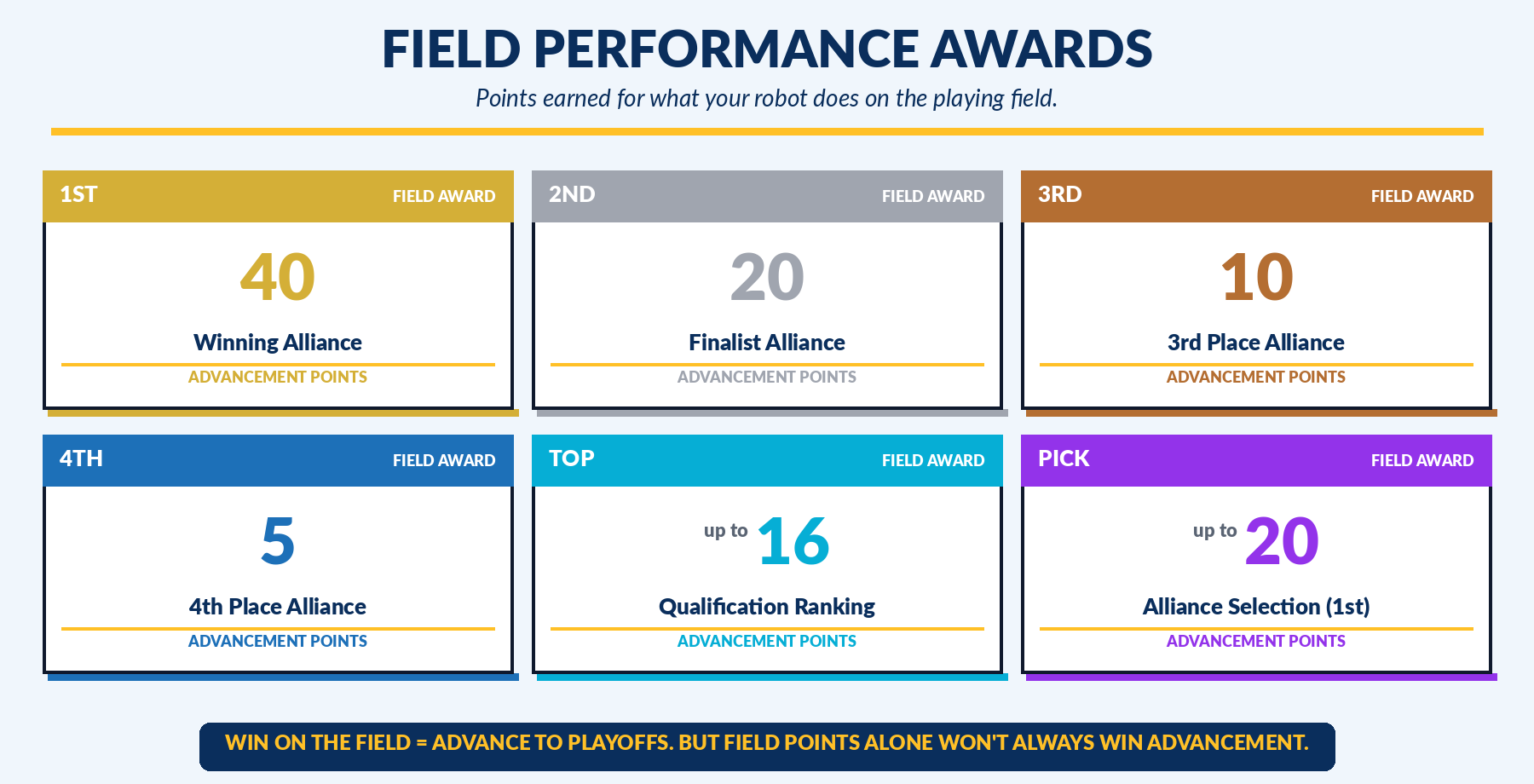
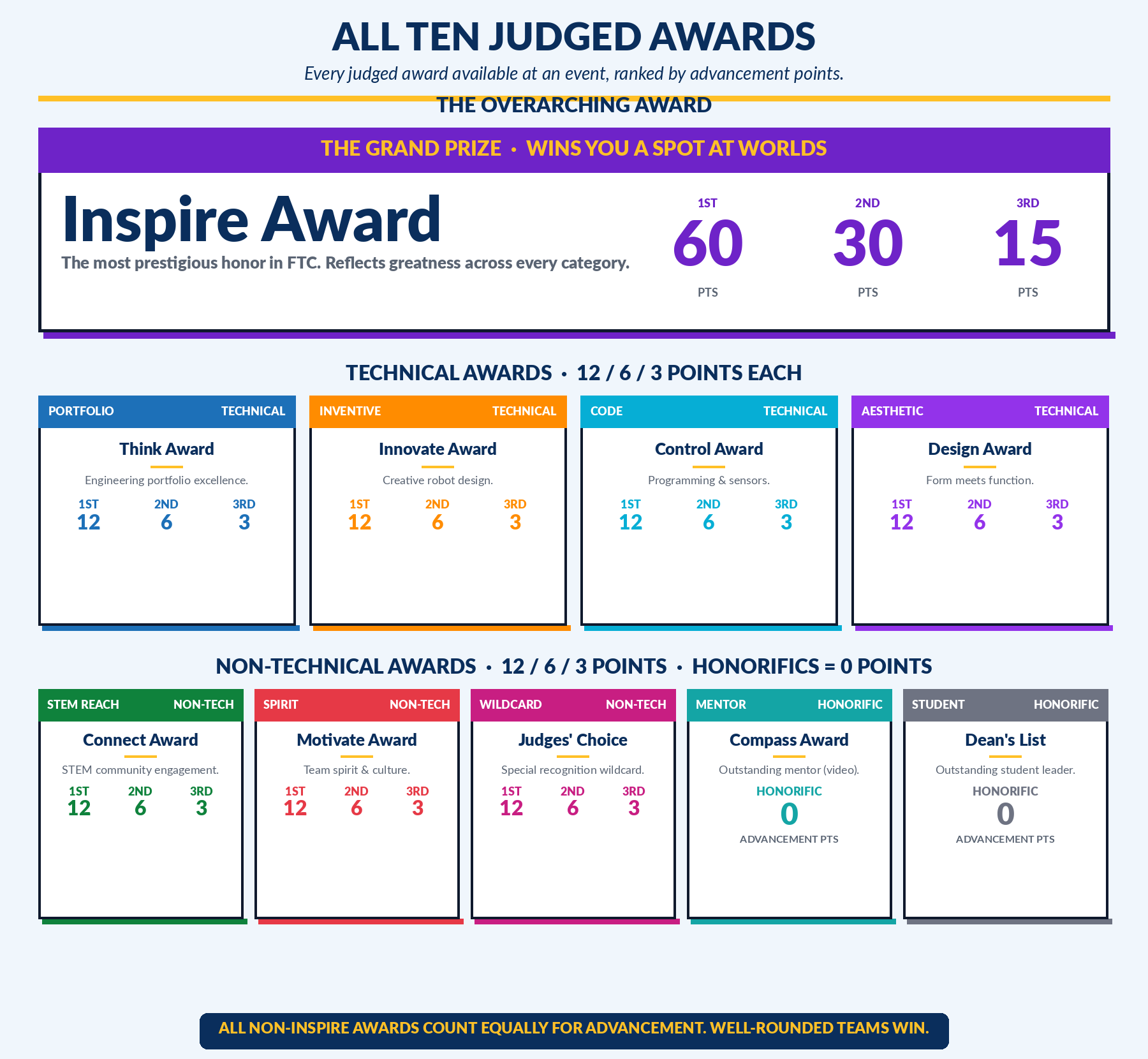
Look closely at these two tables together and something remarkable jumps out. The Inspire Award winner and the Winning Alliance both advance 100% of the time — they are the two guaranteed paths forward at every event. But the Inspire Award at 60 points still outweighs winning the entire field competition at 40 points. That single fact tells you everything about what FIRST values most: the complete, well-rounded team.
All awards other than the Inspire Award are considered equal for advancement purposes and receive the same number of advancement points. This intentionally reflects a focus on rewarding well-rounded teams for their achievements across multiple aspects of an event.
Also note that if an individual is recognized as a Dean’s List Semifinalist or Finalist, or a coach or mentor receives the Compass Award, the team will not receive any advancement points for that individual recognition. Those are honorific awards — deeply meaningful, but they don’t affect advancement standing.
Why the Inspire Award Changes Everything
Look at that table again. A first-place Inspire Award is worth 60 points — five times more than any other judged award, and 20 points more than winning the entire field championship.
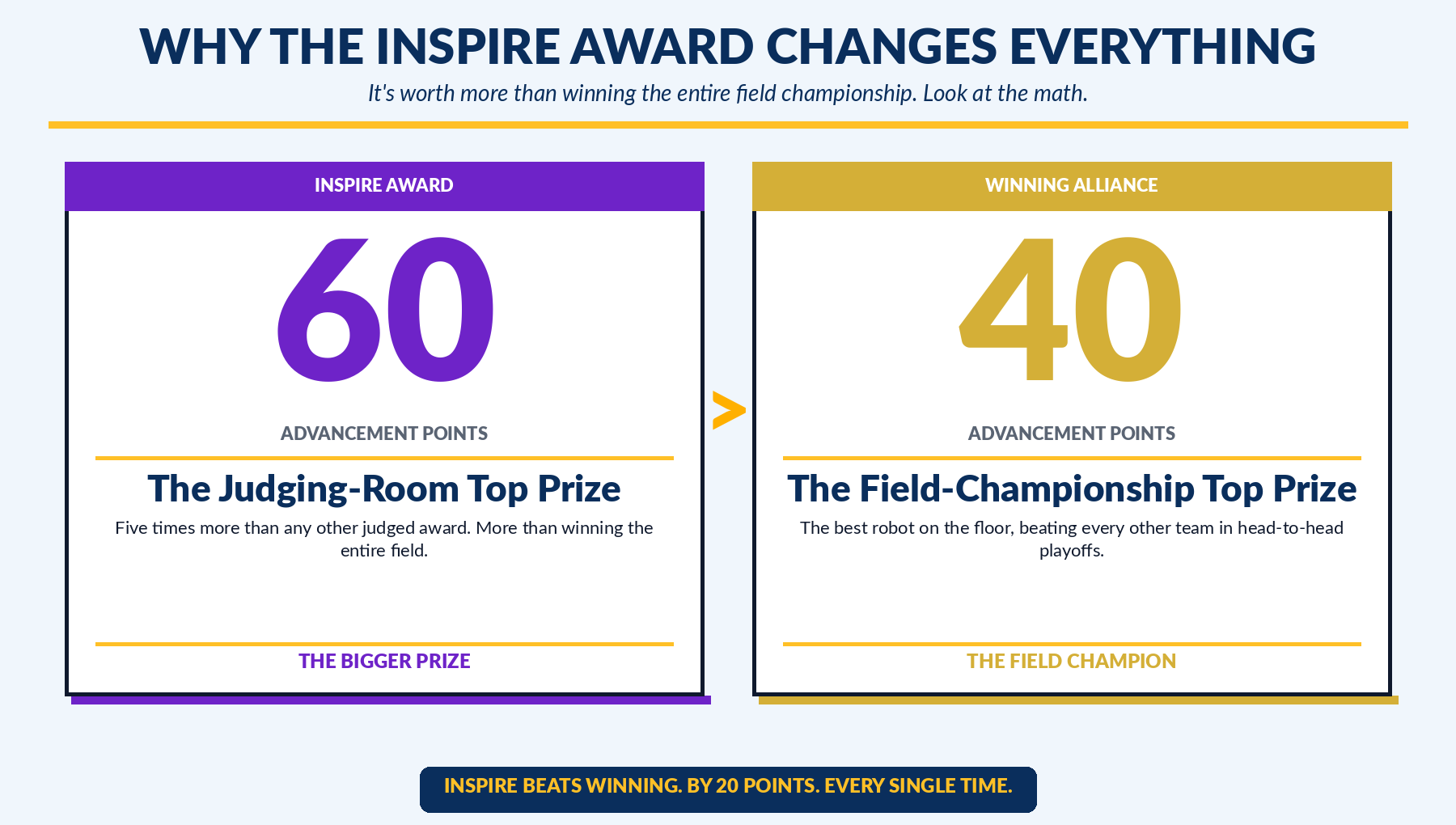
In a sample event simulation from FIRST’s own advancement whitepaper, a team that won the Inspire Award but only finished in a middle-of-the-pack playoff run from the number 4 alliance still earned the most advancement points of any team at the entire event.
That is remarkable. It means a team can lose most of their matches and still advance ahead of teams that won on the field — simply because the judges recognized them as the most complete, well-rounded, and inspiring team at the competition.
The Inspire Award is generally given to teams who achieve greatness in all parts of FIRST including programming, robot design, the portfolio, judging presentations, gracious professionalism, and outreach. This team embodies what it is to be a FIRST robotics team and is a team that others can look up to as a role model.
How Judging Works
Judging at competitions is done through multiple ways including team presentations, pit interviews, and judges reading teams’ engineering portfolios. Judges also observe teams on the field throughout the day, watching not just how their robot performs, but how team members carry themselves, interact with other teams, and demonstrate Gracious Professionalism.
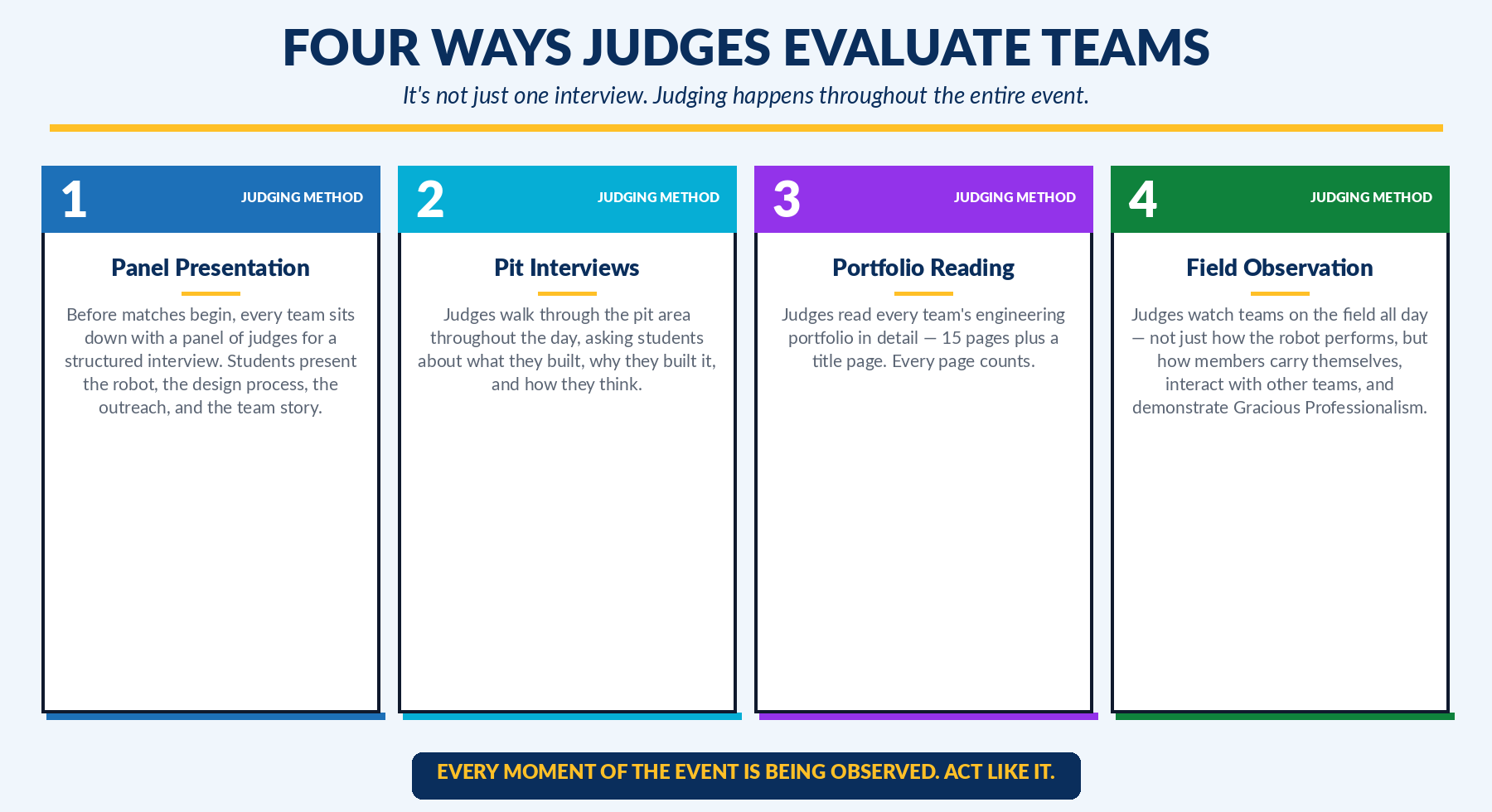
Before matches begin, every team sits down with a panel of judges for a structured interview. Students present their robot, their design process, their outreach efforts, and their team story. This is a real interview — and it counts enormously.
A Complete Guide to Every Award
FIELD PERFORMANCE · 40 / 20 / 10 / 5 POINTS
Winning Alliance & Finalist Alliance — Field Champions
These are the awards earned entirely on the playing field — no judges, no portfolio, no interview. The Winning Alliance is the team that outperforms every other robot in head-to-head playoff competition. The Finalist Alliance made it all the way to the championship match. These are prestigious, hard-fought recognitions that demonstrate pure competitive excellence on the field.
However — and this is critical — winning the field alone is not enough to guarantee advancement at a competitive event. Under the new advancement system, teams accrue advancement points throughout an event, and at the end of the event the top teams according to advancement points advance. A team that wins the field but earns no judged award points may still be overtaken in the advancement standings by a team that performed well across all categories.
OVERARCHING · 60 / 30 / 15 POINTS
Inspire Award — The Grand Prize
The Inspire Award is given to a team that consistently rises to the top in other award categories. Of all the awards, it is arguably the most subjective, as it reflects how well a team does overall — including outreach, documentation, robot performance, and team culture. To be a true contender, a team must be strong across every single judging category simultaneously. There are no shortcuts here.
What makes this hard: To win the Inspire Award, your robot must be competitive, your portfolio must be comprehensive and professional, and your outreach must be meaningful. Excellence in all judged categories is the goal. You must simultaneously be a contender for at least one technical award AND at least one non-technical award AND submit an outstanding portfolio. It is the ultimate test of a well-rounded team.
TECHNICAL · 12 / 6 / 3 POINTS
Think Award — The Engineering Portfolio
The Think Award is given to the winning team that clearly displays their engineering and design process in their engineering portfolio. This award honors the team whose engineering content clearly displayed the mathematics, science, and design process that went into the building of their robot.
The non-technical requirement: This award is 100% documentation. Not a single point comes from how your robot performs on the field. The portfolio must include:
- Evidence of the engineering design process in action
- Lessons learned, trade-off analysis, cost-benefit analysis, and mathematical analysis used to make design decisions
- Examples of science, math, and game strategies and their application into designing and building the robot, and progression through the Engineering Design Process showing lessons learned in both mechanical and non-mechanical areas
The judges are not just reading about your robot — they are reading the story of how your team thinks, learns, and grows. A team with a mediocre robot but an extraordinary portfolio can and does win this award.
TECHNICAL · 12 / 6 / 3 POINTS
Innovate Award — Creative Robot Design
The Innovate Award celebrates a team that has the ingenuity and inventiveness to make their designs come to life. It is given to the team the judges feel has the most innovative and creative robot design solution to the season’s game. Elements of this award include elegant design, robustness, and “out of the box” thinking. This award may recognize the whole robot or a single brilliant sub-assembly component — as long as it works consistently and demonstrates genuine creative engineering.
The non-technical requirement: Your innovative mechanism alone is not enough. The team’s engineering portfolio must include a summary of the design of the component or components and the team’s robot to be eligible for this award. Entries must describe how the team arrived at their solution. Teams should highlight one or more original subsystems or mechanisms that are unique to their robot, show the inspiration, design process, and functionality, and use CAD or prototype images in the engineering portfolio.
One important warning: calling a standard solution “innovative” will hurt your credibility. Teams must prove innovation by contrasting their solution with other approaches and demonstrating its unique benefits. You must be able to tell the story of why your solution is different — and prove it on paper.
TECHNICAL · 12 / 6 / 3 POINTS
Control Award — Programming and Sensors
The Control Award commends the team that had the best use of unique programs and successful sensors used in their matches. The team’s engineering portfolio must be very detailed in explaining their implementation of software, sensors, and mechanical control.
This is the award for teams that push the boundaries of what their robot’s software can do — advanced autonomous routines, creative sensor integration, and intelligent real-time decision-making during matches.
The non-technical requirement: Your code running well on the field is necessary but not sufficient. The team’s engineering portfolio must contain details about the implementation of the software, sensors, and mechanical control, but does not need to include copies of the code itself. Teams should document code structure, sensor use, and strategic algorithms, show how their software assists the drivers during TeleOp, and provide annotated code snippets or flowcharts.
The Control Award also requires a separate submission form no longer than 2 pages in addition to the main portfolio. Your programmers need to be writers too.
TECHNICAL / AESTHETIC · 12 / 6 / 3 POINTS
Design Award — Form Meets Function
The Design Award recognizes design elements of the robot that are both functional and aesthetic. It is presented to teams that incorporate industrial design elements into their solution. These elements could simplify the robot’s appearance by giving it a clean look, be decorative in nature, or otherwise express the creativity of the team. The robot should be durable, efficiently designed, and effectively address the challenge. Think of this as the award for a robot that is not only impressive to watch — it’s impressive to look at.
The non-technical requirement: The portfolio must include a summary of the design solution and describe how the team arrived at their solution. Teams should include CAD drawings, robot sketches, and documentation explaining how aesthetic and functional design choices were made intentionally — with purpose and planning, not by accident. The judges want to see that beauty and function were both considered from the very start of the design process.
NON-TECHNICAL · 12 / 6 / 3 POINTS
Connect Award — STEM Community Engagement
The Connect Award is granted to the team that most connects with their engineering community outside of FIRST by sharing who they are, what FIRST is, and how others can become involved.
This award rewards teams that build real relationships with engineers, companies, universities, and STEM professionals. It’s not just about having sponsors — it’s about creating genuine two-way partnerships where professionals mentor the team and the team actively helps spread the FIRST message into the broader community.
NON-TECHNICAL · 12 / 6 / 3 POINTS
Motivate Award — Team Spirit and Culture
The Motivate Award goes to the team that exemplifies what it means to be a FIRST team. This team works together by showing Gracious Professionalism at competitions and by recruiting and assisting other teams and members at home.
This award celebrates the team that brings the most energy, spirit, and enthusiasm — the team that cheers for everyone, helps competitors when they’re struggling, and makes everyone feel welcome. Team spirit, community recruiting, creative team identity, and consistent enthusiasm all play a role here.
NON-TECHNICAL · 12 / 6 / 3 POINTS
Judges’ Choice Award — The Wildcard
The Judges’ Choice Award is given to a team that the judges believe deserves recognition but wouldn’t otherwise qualify for an existing award. The award can be given under a different name depending on the region.
This is the judges’ way of saying: we saw something special here that doesn’t fit a category, but we can’t let it go unrecognized. It’s often awarded to rookie teams making a remarkable first impression, or teams overcoming unusual challenges with exceptional grace and determination.
NON-TECHNICAL · HONORIFIC — 0 ADVANCEMENT POINTS
Compass Award — Outstanding Mentor
The Compass Award is an optional award given to a team that creates a 60-second video recognizing a coach or mentor and highlights what sets them apart. Students nominate and celebrate the adult who made the biggest difference in their season. While this award earns no advancement points, it is one of the most personally meaningful awards a team can receive — and producing the video itself is a wonderful team-building exercise.
NON-TECHNICAL · HONORIFIC — 0 ADVANCEMENT POINTS
Dean’s List Award — Outstanding Student
The Dean’s List Award recognizes individual students who demonstrate extraordinary leadership, dedication, and effectiveness in spreading the FIRST message in their communities. Teams nominate their most outstanding student members, who then go through a separate interview process. Finalists and winners earn recognition that carries real weight in college applications and scholarship opportunities — even though the team receives no advancement points for this honor.
The Big Picture: You Have to Win Both Ways
Here’s the bottom line: in FTC, there is no shortcut. You can’t win by just building an incredible robot and ignoring the judging process. And you can’t win by being a wonderful community ambassador with a robot that falls apart on the field. FIRST Tech Challenge is more than a robot competition — the judged awards represent a positive way to recognize teams who embody important values like Gracious Professionalism, teamwork, creativity, innovation, and the value of the engineering design process.
Notice something important:
Even the purely technical awards require written documentation, clear communication, and storytelling. Your programmers must write about their code. Your builders must document their design process. Your engineers must explain their math.
There is no such thing as a purely technical team in FTC — every student must be able to communicate what they built, why they built it, and what they learned along the way.
OUR TEAM
We’re building engineers, communicators, leaders, and community ambassadors.
For our team, this means we are building something much bigger than a machine. Every award category is a skill we are actively developing — and we are proud to be pursuing all of them.
Stay tuned as we share updates on our engineering portfolio, our outreach efforts, and our journey through the Aero Coast League this season.
We’re not just here to compete — we’re here to inspire.
Go deeper
Read more about the documents and the cooperation that drive FTC.
The Engineering Portfolio »
Award-Winning Portfolios »
What is Coopertition? »